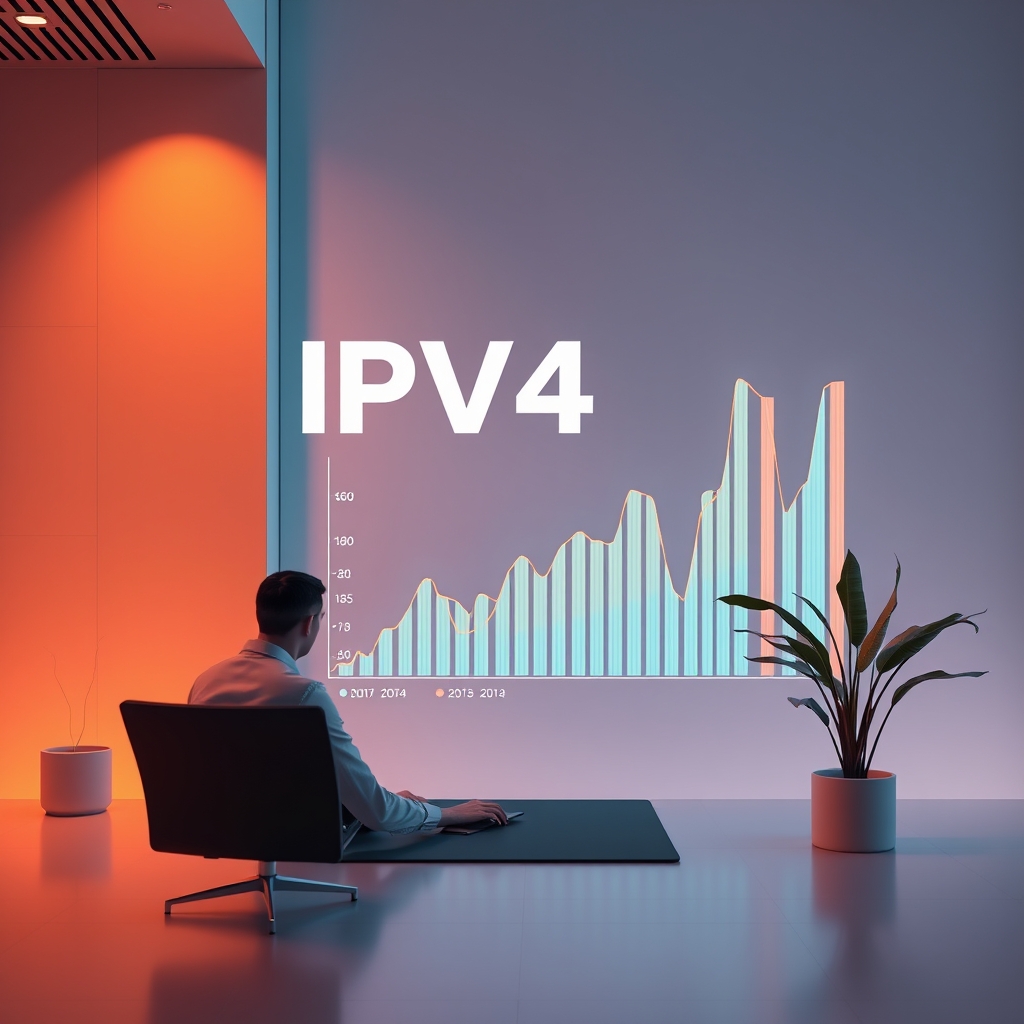
The landscape of internet infrastructure is changing rapidly. It’s happening right under our feet. Few metrics illustrate this shift as clearly as IPv4 price trends. For network engineers and IT managers, the days of viewing IP addresses as a trivial line item are long gone. Those times are over. As the pool of unallocated IPv4 addresses dries up, the market has transitioned into a robust secondary economy where supply and demand dictate costs. Understanding these trends is no longer just an exercise in economics; it is a critical component of strategic network planning.
Need IPv4 addresses?
Browse clean, RIPE-verified subnets at $0.50/IP/month.
Historical Context: From Free Resource to Scarce Asset
To understand where we are going, we must look at where we have been. You can’t move forward without checking the rearview mirror. In the early days of the internet, IPv4 addresses were essentially free, allocated on a first-come, first-served basis by IANA and Regional Internet Registries (RIRs) like ARIN, RIPE NCC, and APNIC. However, the exhaustion of the central pool in 2011 marked a turning point. Things changed. Since then, the transfer market has become the primary mechanism for acquiring blocks.
Initially, prices hovered around $5 to $10 per IP. It feels cheap now. But as cloud computing expanded and the Internet of Things (IoT) began to take shape, demand began to outstrip the supply of reclaimed addresses. This scarcity has created a seller’s market that shows no signs of reversing, making it essential for stakeholders to monitor IPv4 price trends closely when budgeting for future expansion.
Current Market Data: Analyzing the Numbers
Recent market data indicates a consistent upward trajectory in pricing across all major RIR regions. While prices fluctuate based on block size and specific regional policies, the general consensus is one of appreciation. It’s not slowing down.
| Region | Approx. Price per IP (/24 block) | Market Trend |
|---|---|---|
| ARIN (North America) | $45 – $60 | High Demand / Stable Supply |
| RIPE (Europe) | $40 – $55 | Steady Growth |
| APNIC (Asia Pacific) | $35 – $50 | Rapidly Increasing |
| LACNIC (Latin America) | $25 – $40 | Volatile / Rising |
As shown in the table above, North America currently commands the highest prices due to the high concentration of cloud providers and enterprises requiring large-scale deployments. It’s a heavy demand. However, the Asia-Pacific region is witnessing the fastest growth rate as digital transformation accelerates in developing economies.
Key Drivers Behind the Price Surge
Several factors are converging to drive these costs upward. Understanding these drivers helps network managers predict future budget requirements. It’s about anticipating the pinch before it hurts.
1. The Cloud and CDN Expansion
Major players like AWS, Azure, and Google Cloud continue to expand their footprints. While they are heavily investing in IPv6, the sheer volume of legacy applications requiring IPv4 ensures their demand remains high. Content Delivery Networks (CDNs) also require massive numbers of IPs to ensure low latency, further tightening the market.
2. IoT and Mobile Device Proliferation
While carriers often use Carrier-Grade NAT (CGNAT) to connect IoT devices, many enterprise IoT deployments require public addressing for secure, direct communication. This adds a new layer of demand from sectors that previously did not consume large amounts of IPv4 space.
3. Regulatory Hoarding
Some organizations hold onto larger blocks than they strictly need, viewing them as appreciating assets. This hoarding reduces the liquidity of the market, putting further upward pressure on prices.
Market Forecast: What to Expect in 2025 and Beyond
Forecasting the exact value of an asset is challenging. It’s never a sure bet. But analysts agree on the general direction of IPv4 price trends: up. We predict that by the end of 2025, the average price per IP in ARIN could breach the $65 mark, with other regions following closely behind.
The primary variable is the rate of IPv6 adoption. While IPv6 is the long-term solution, the transition has been slow. Slower than many hoped. Dual-stack networks require both IPv4 and IPv6, meaning the need for IPv4 will persist even as IPv6 usage grows. This “long tail” of dependency ensures that IPv4 will remain a valuable commodity for at least the next 5 to 10 years.
Furthermore, as smaller blocks become harder to find, the premium on larger, contiguous blocks (like /16s) will increase disproportionately. Organizations needing clean reputation history and no past blacklisting will pay a premium for “clean” blocks.
Practical Steps for Network Engineers
Given the forecast, what should IT managers and ISPs do? Procrastination is the enemy of cost efficiency. Waiting usually costs more.
- Audit Current Usage: Identify unused or underutilized space within your organization that can be re-purposed or sold.
- Forecast Needs Early: Don’t wait until your current allocation is exhausted. Start the acquisition process 6-12 months in advance.
- Consider Leasing: If capital expenditure (CapEx) is a constraint, leasing can be a viable short-term strategy, though buying is often more cost-effective over a 3-5 year horizon.
- Use a Trusted Platform: Navigating the transfer process involves complex RIR policies and legal hurdles. Using a verified marketplace reduces risk and ensures a smooth transfer.
Secure Your Assets Today
The cost of waiting is not just about higher prices; it is about the risk of unavailability. As the market tightens, finding specific block sizes or regional resources may become difficult. IP4 Market provides a secure, regulated environment for buying, selling, and leasing IPv4 addresses. With verified sellers and competitive pricing, we ensure that you acquire the resources you need without the administrative burden.
Frequently Asked Questions
Why are IPv4 prices rising if IPv6 exists?
IPv6 adoption is increasing, but the majority of the internet still runs on IPv4. Dual-stack requirements mean businesses need IPv4 to communicate with the legacy internet, ensuring continued demand.
Is it better to buy or lease IPv4 addresses?
Buying is generally better for long-term stability and investment value, as you own the asset. Leasing is suitable for short-term projects or to manage immediate cash flow constraints.
How long does an IPv4 transfer take?
The timeline varies by region (RIR), but it typically takes between 4 to 12 weeks to complete a transfer once the agreement is signed and pre-approval is obtained.
Need IPv4 space? Lease RIPE-verified /24–/22 subnets at a flat €0.50/IP per month — LOA + RPKI/ROA in minutes, instant company verification, automatic renewals. Browse available subnets →