
If you run a network, an ISP, or infrastructure for a growing enterprise, you already know the question that keeps coming up: what will IPv4 actually cost us? Ever since IANA drained the central pool back in 2011, the secondary market has set the real price of address space — and that price shifts depending on which of the five Regional Internet Registries you’re dealing with. Here we compare pricing by RIR, look at what drives the regional gaps, and pass along some hard-earned advice on transacting safely this year.
Need IPv4 addresses?
Browse clean, RIPE-verified subnets at $0.50/IP/month.
The State of the IPv4 Market
The last decade has been quite a ride. Addresses hovered around $1–2 apiece in 2015. Then the climb began — cloud expansion, hybrid work, hyperscale computing — until late 2021, when a single address could fetch $50–60 at the peak. Since 2023 things have cooled. Prices settled into the $30–40 range, and for buyers, that stability is welcome after years of chasing a moving target.
Every so often someone predicts the market will collapse once IPv6 takes over, or when a cloud provider returns unused blocks. It hasn’t happened. Demand for legacy IPv4 stays strong, and the market itself has grown up: it’s liquid now, professionally intermediated, with tens of millions of addresses changing hands each year.
IPv4 Pricing Across the Five RIRs
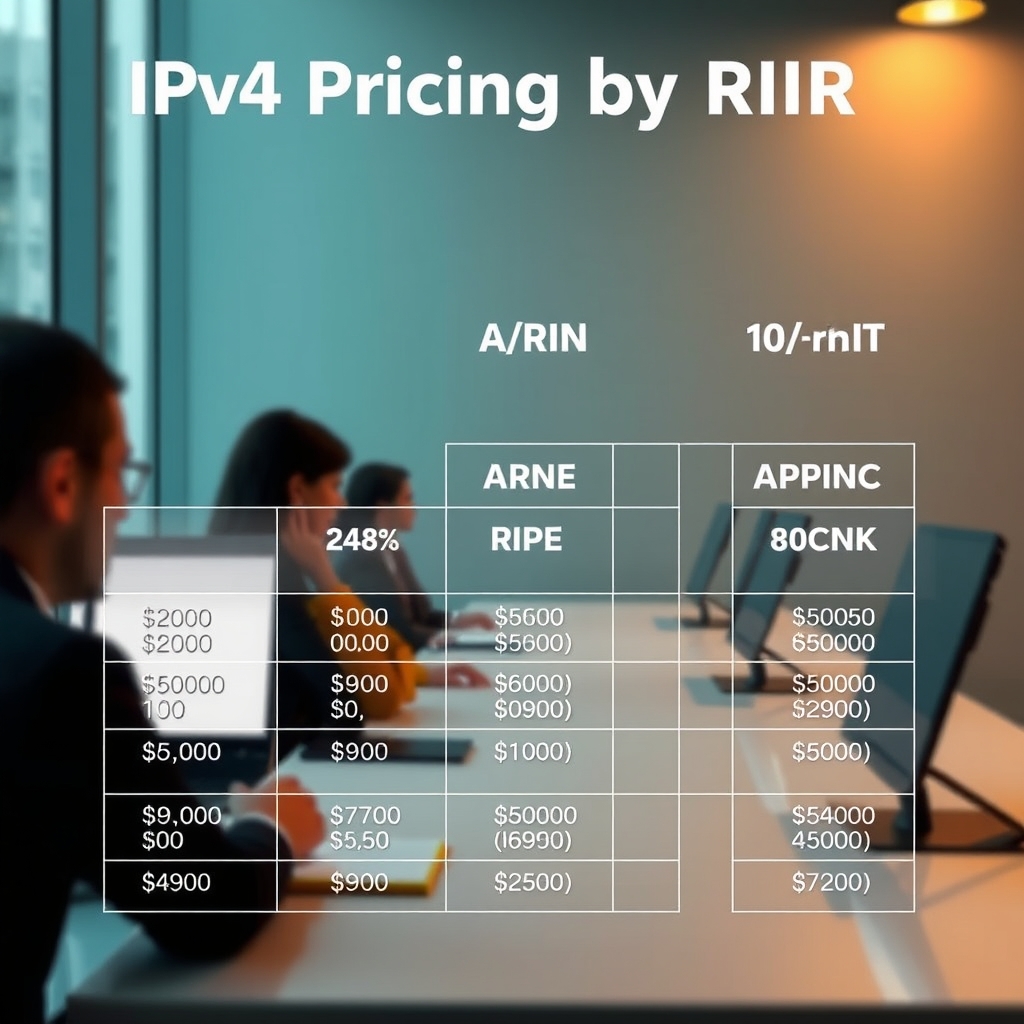
ARIN, RIPE NCC, APNIC, LACNIC, and AFRINIC each govern transfers within their own regions. The asset itself is identical everywhere — routable IPv4 space — but pricing, transfer policy, and how easily blocks actually move vary a lot from region to region.
ARIN (North America)
ARIN is still the deepest market. Its transfer policies, covering both specified and unspecified transfers, are well tested and support serious volume. A /24 under ARIN typically trades between $32 and $40 per address, and bigger blocks (/16s, /17s) can command a small premium because aggregation is worth something. Add a mature broker ecosystem and steady M&A activity, and you get the most reliable price discovery of any region.
RIPE NCC (Europe, Middle East, Central Asia)
RIPE prices track ARIN closely, usually within 5–10%. Holders must demonstrate usage before transferring, and LIR-to-LIR transfers have become routine. One thing buyers often overlook: the receiving LIR takes on annual membership fees, which nudges up total cost of ownership. RIPE /22s have held consistently in the mid-$30s per address.
APNIC (Asia-Pacific)
Demand from Asia’s fast-growing digital economies pushes APNIC prices a modest 5–15% above ARIN equivalents. The transfer policies themselves are clear, though cross-region transfers into APNIC come with their own documentation requirements. Blocks with a clean routing history in major Asian markets are the ones everyone wants.
LACNIC (Latin America)
Smaller market, less liquidity — which means wider bid-ask spreads. Transfers have picked up since policy liberalization, but pricing swings more block by block. If you’re actually deploying in Latin America, a LACNIC block can justify the premium. Otherwise, most operators buy ARIN or RIPE space and announce it regardless of region.
AFRINIC (Africa)
This is the trickiest region. Transfer policies arrived relatively late, and governance disputes have muddied expectations around processing timelines. IPv4 pricing here is far less standardized, and plenty of African operators simply source their space from other regions instead.
| RIR | Typical Price / Address | Market Liquidity | Key Consideration |
|---|---|---|---|
| ARIN | $32–$40 | High | Deepest market, fast processing |
| RIPE NCC | $30–$38 | High | LIR membership fees for buyers |
| APNIC | $35–$45 | Medium-High | Regional demand premium |
| LACNIC | $28–$40 | Medium | Wider spreads, smaller volume |
| AFRINIC | Variable | Low | Policy and processing uncertainty |
Note: Figures reflect typical 2024–2025 market ranges for clean, routable /22–/24 blocks. Actual pricing depends on block size, prefix length, and history.
Factors Driving Regional Price Differences
Block Size and Prefix Length
Everywhere you look, /24s are the most liquid denomination. They fit cleanly into the global BGP table and suit cloud providers down to the ground. Larger blocks (a /16, say) often get a per-address discount in bulk deals. Sub-/24 space? Almost never traded.
Registry Processing Speed
ARIN and RIPE usually close a transfer within weeks. Others take longer, and slower settlement means more escrow risk — which is why speed gets priced into premiums.
Cleanliness and RPKI Status
A block free of blacklists, hijack history, and geolocation oddities sells for more. Full stop. Buyers increasingly insist on RPKI readiness and clean WHOIS records before they’ll sign anything.
Cross-Border Transfer Rules
All five RIRs allow inter-RIR transfers under IANA’s framework, but each sets its own documentation and eligibility bar. That affects both your timeline and your bill.
Practical Tips for Buyers and Sellers
- Verify the seller’s legitimacy. Confirm WHOIS registration and resource holder authorization, and make sure the block isn’t tied up in disputes or liens.
- Use independent escrow. No funds released before the registry confirms the transfer. None. Reputable marketplaces include escrow by default.
- Check block history. Dig into routing history, spam blacklists, abuse records. A contaminated block will haunt your deliverability and reputation long after the deal closes.
- Match block size to your needs. One /22 usually beats four /24s on per-address cost and simplifies your BGP announcements.
- Time your transaction. Prices are stable right now, but big moves by cloud providers can shift things fast. Watch the trends before committing to a bulk purchase.
Frequently Asked Questions
Why do IPv4 prices differ between RIRs?
Regional demand, transfer policy maturity, processing speed, and liquidity all play a part. ARIN and RIPE price most consistently because their secondary markets are deep and active.
Can I transfer IPv4 blocks between RIR regions?
Yes. Inter-RIR transfers are permitted under each registry’s policies, though documentation and timelines vary. Many buyers find it simpler to just purchase blocks already registered in their target region.
Will IPv6 adoption reduce IPv4 prices?
IPv6 keeps growing, but legacy IPv4 remains essential — reachability, CGNAT offloading, cloud services. Most analysts expect steady demand, and with it, stable pricing for the foreseeable future.
What is the smallest transferable block?
A /24. It matches the smallest globally routable prefix, and most RIR transfer policies treat it as the floor for market transactions.
Conclusion: Navigating IPv4 Pricing with Confidence
Each region tells its own story. ARIN and RIPE offer the best mix of liquidity, clean history, and predictable settlement for most buyers; APNIC carries a demand premium; LACNIC and AFRINIC demand more patience and homework. Wherever you buy, the formula for a safe deal doesn’t change: verified counterparties, transparent pricing, protected transactions. IP4 Market was built around exactly that — KYC-verified sellers, independent escrow, and market-accurate pricing, whether you’re picking up your first /24 or offloading a large portfolio.